
First presenting the political program of establishing a single and inclusive democracy over historic Palestine – the 10-point program formulated by the Palestinian-led One Democratic State Campaign, of which ICAHD is a charter member. Since this approach to achieving justice in Palestine/Israel is just in its infancy, much work and discussion are still needed before a critical mass of Palestinians adopt it, the intent is not (at this stage) to recruit people to the idea, but to open a discussion of a future resolution that will bring direction, focus and engagement to international supporters of the Palestinian struggle who need to see a way forward if they are to continue to be involved.
Second, by sharing what is happening in Palestine (heightened repression, demolitions, loss of land and settlement, Israel’s final push to consolidate its apartheid regime), analysis made more visual, powerful and understandable by the powerpoint presentation Jeff uses, activists are kept up-dated and motivated. Targeting strategic populations (students, activists on other issues, churches, the media and decision-makers), as well as the general public, grows our ranks.
In order to engage meaningfully with activists and the public, Jeff spends a week or so in selected areas. He began in Indiana and Michigan, where he was hosted by the Indiana Center for Middle East Peace (its Director, Michael Spath, is also the co-Director of ICAHD USA). From there he traveled to Boston, one of the centers of Palestinian advocacy in the US, where he met with key activists. He then finished his tour in Texas, presenting in Denton and Dallas, Houston and San Antonio. One meeting that stood out among the many he had was a presentation and discussion at the University of Houston, sponsored by Students for Justice in Palestine. Young Palestinians, be they in Palestine or in the Diaspora/Exile, are the key to the future of their people and, indeed, the region. It was a good if sometimes contentious meeting as Palestinian students struggle with the tension between absolute justice and the need to envision a future they must share with Israelis, who will remain a permanent presence in the country, albeit in a decolonized state.
At time when nothing has happened politically in Palestine/Israel for years (the last negotiations, futile as they were, were held by Kerry in 2014), when many feel a sense of helplessness as Israel mops up Palestinian resistance and establishes its apartheid regime, supported as always by the governments the world over, including Arab and Muslim ones, and when the Palestinians themselves lack leadership, organization and a political program, it is crucial to keep the international grassroots focused, political and engaged – knowing that the struggle is ultimately winnable.
Israel may be strong among governments, but that support is shallow and changeable. Israel has already lost in the Court of Public Opinion, which is why it has been reduced to weaponizing antisemitism. By contrast, the Palestinians are stronger than even they realize, having the support of masses the world over. Those masses, however, including the thousands of solidarity groups active around the world, need to be constantly re-energized and focused as we pass through this phase of the Palestinian struggle – which may be an extended one – in which the Palestinians themselves must re-engage with their far-flung communities in forging a way forward, one that then becomes our marching orders.
After 25 years as the head of ICAHD and thousands of meetings and presentations the world over, Jeff says the time is approaching when a new generation of advocates must step into the breach, Palestinian, critical Israeli and international alike. He remains ready – indeed eager – to help train that cadre.
Khalil Alamour stands on a hill overlooking Hura, one of the towns that Israel has created to accommodate Palestinian Bedouins from the 35 unrecognised villages in the Naqab (Negev). There are seven such towns - reservations - and the Bedouins moved to them find living hard because they are used to their agricultural way of life and not crammed into small spaces. The Jewish National Fund continues to be very active in the Naqab and is instrumental in pushing the indigenous population off their land.
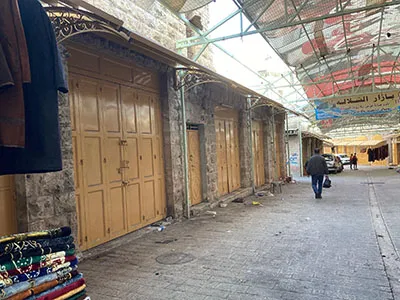
More shops in Hebron’s Old City have closed with doors welded shut so this area is becoming even more like a ghost town. Few local people go into the Old City for their shopping and international visitors are reduced in number compared to previous years before the arrival of Covid. Israeli surveillance is everywhere through cameras and the presence of the Israeli army. The atmosphere is oppressive.
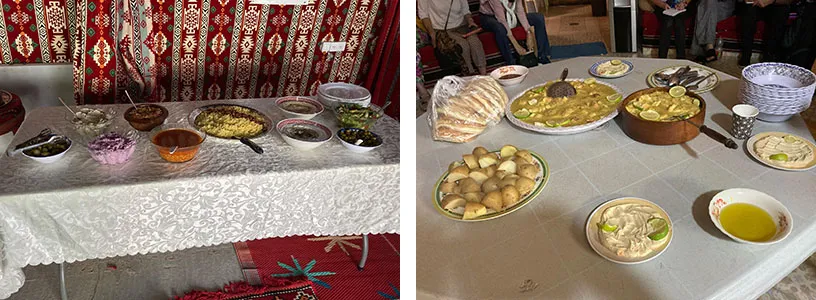
The wire structure was erected by Palestinians to protect the people from the rubbish thrown down by the extreme religious Jewish settlers who have taken over the apartments above the shops. Palestinian hospitality is as welcoming and generous as ever. Getting out amongst the locals provides memories that are never forgotten by international tour participants. It is not normal practice for Palestinians to use chemicals in their food production. For centuries they have respected the earth and tended their plants with loving care. They are skilled in seasoning their dishes using locally grown herbs and spices which results in tasty meals. The photos are from traditional meals that are served in the Naqab and in the Jordan Valley. However whatever fruit and vegetables Palestinians cannot grow themselves must be purchased from shops and market stalls where most of the produce they sell is supplied by Israel. The occupying power controls the water available to farmers and many farmers simply cannot afford to pay for it. In addition, due to land confiscation, Palestinians have lost much of their land. Israeli produce is sold at a lower price compared to what is economical for Palestinian production. The Palestinian population cannot afford to pay a premium price for the fruit and vegetables raised by Palestinian farmers.
Because of the fragmentation of the Palestinian people on the ground (those living in the West Bank, East Jerusalem, Gaza, and within ‘48 Israel), their realities and how they are impacted are different which means the approaches to the treatment that is provided must vary. Traditionally, seeking help for mental health issues has not been part of Palestinian culture; it was not understood and even discouraged. In recent years professionals from the fields of mental health and social work have been given time to speak on radio and television stations and some of them also write articles as they seek to bring understanding about stress and psychosocial problems that result because of living in a colonised society that leads to diseases such as high blood pressure, diabetes, heart disease, depression, sleep dysfunction etc.. Increasing numbers of students are training in the field of mental health and more Palestinians are seeking treatment, a need which is currently hard to meet.
Yet again it was stressed that political work is needed because only providing humanitarian aid will not get to the root of the problem. Dates for Your Diary
From all at ICAHD UK. https://www.facebook.com/pages/Israeli-Committee-Against-House-Demolitions-UK/366423593418140 Facebook https://www.twitter.com/ICAHDUK/ Twitter http://icahduk.org Website mailto:info@icahduk.org Email
October 2022 Newsletter
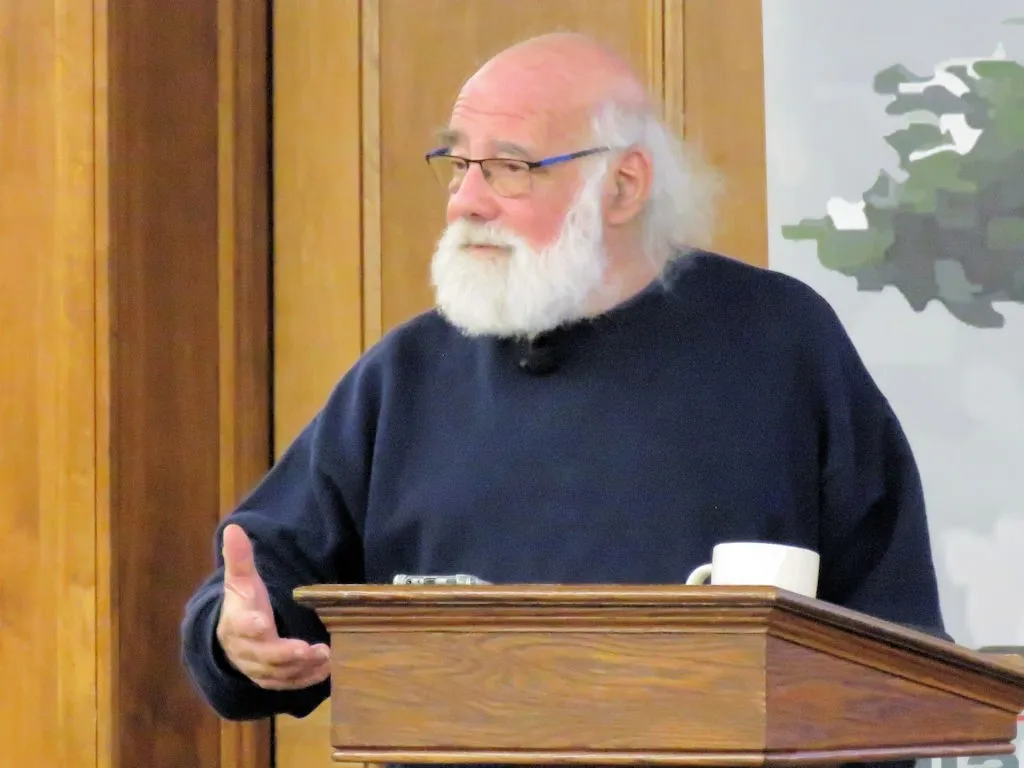
Jeff Halper's US Tour Following the corona hiatus in the work and lives of many of us, Jeff Halper has returned to the “campaign trail.” After a three-week tour of the UK in September, he departed in October for a month-long tour beginning in Italy (Turin and Milan) and continuing in the US. At this stage of the struggle for Palestinian rights, the purpose of his tours is two-fold.
View a recording of one of Jeff's US meetings here
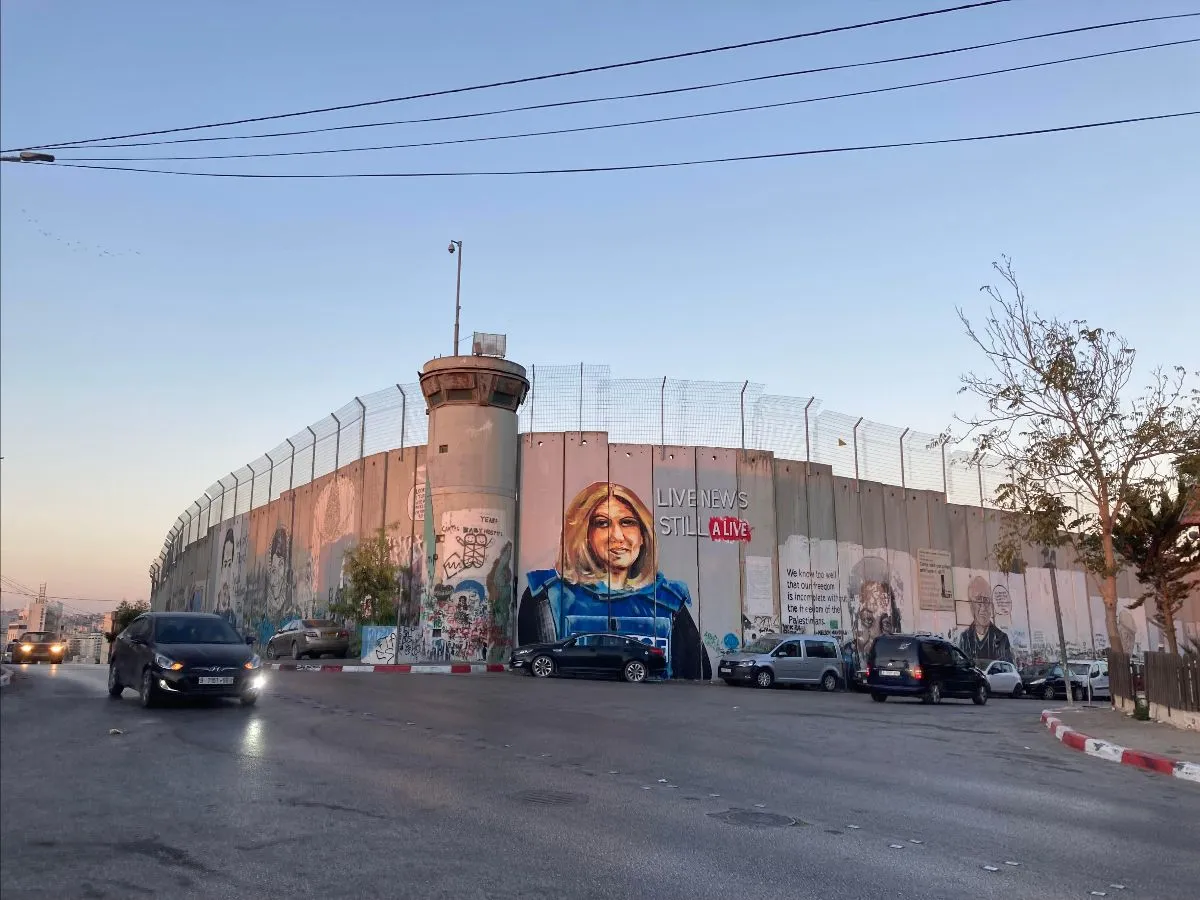
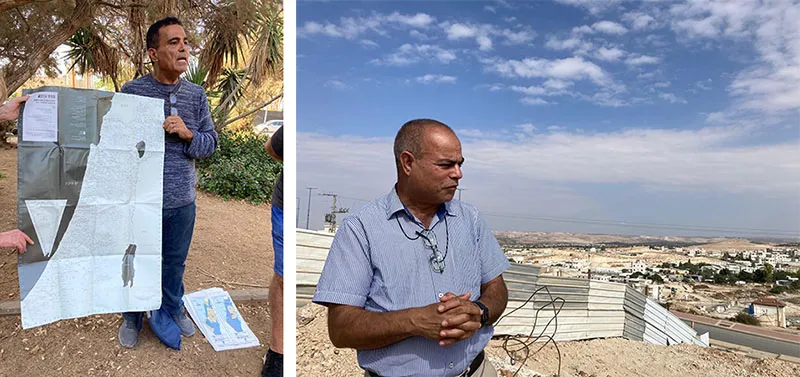
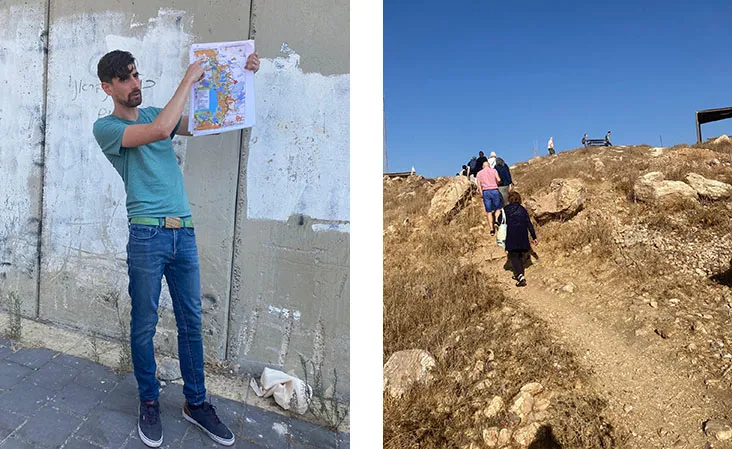
An audio recording of Jeff's talk in Houston is also available (Jeff starts speaking about 9 minutes into the recording) (https://www.arabvoices.net/archives/ArabVoices102722.mp3) Returning to Palestine/Israel A representative of ICAHD UK has been in the OPT (Occupied Palestinian Territory) and Israel leading another study tour and sends a few photos with some accompanying information. She has been there at a time when violence has again escalated especially in the north of the West Bank and in East Jerusalem. Israeli authorities are conducting night raids; Palestinians, including teenagers, are being arrested and killed, and some Israelis have been killed. There are restrictions to movement, delays at checkpoints and some roads are closed especially around Nablus. Once again fear is rising in Palestinian communities as they see no end in sight because no meaningful pressure is being put on Israel to end its violations of international law. International civil society has a strategic role in helping to bring justice and for that, people need to be educated. Nothing does that better than actually going there to witness the reality on the ground. This autumn there is high demand by international visitors for ICAHD’s half-day tours. Pictured is Philip Ben-Shmuel, one of ICAHD’s three guides. During the tours, participants get off the bus for explanations at vantage points that allow them to view the growth of settlements, Israeli highways, the location of the apartheid wall, the different infrastructure for services provided for Israeli Jews compared to the Palestinian population. The shrinking space for Palestinian residents of East Jerusalem is easily distinguished. Israel has created barriers to separate not only the different populations but even Palestinians from other Palestinians. In high population areas, an eight metre high cement wall has been constructed and in rural areas there is a fence with rolls of barbed wire and surveillance roads that run along side it which confiscates even more Palestinian land. These barriers are another example of Israel's apartheid policy. Graffiti is found on the cement walls as is seen when entering Bethlehem through Checkpoint 300, in this case commemorating the murder of Shireen abu Akleh. This photo was taken on the corner across from the Bethlehem Inn Hotel. The study tour also engaged with Palestinian citizens of Israel who described aspects of their work. Educator and researcher Umar al-Ghubari holds a map that shows the location of the 600 towns, villages and agricultural communities that were destroyed during the Nakba, the “catastrophe’ when 800,00 Palestinians where made refugees in and around 1948, when the state of Israel was established. Modern maps do not indicate where these villages used to be and where the ethnic cleansing took place. The tour participants discovered that when they walked along the beach in Tel Aviv towards Jaffa, they were actually walking over what used to be the town of Al-Manshiya, home to 12,000 Palestinians and 1,000 Jews, destroyed during the Nakba.
Read moreA few brief remarks from discussions with those on the ground
The tour participants had encounters with Palestinians who work in the field of mental health who have come to realise that colonisation occupies the mind and the way that people think. These professionals conclude that a new framing is needed - one that identifies liberation psychology. They cannot be neutral because when working within their field, providing services to the Palestinian population, they take the side of justice so they come from a different place when offering treatment.
7 –17 November – Study tour to Palestine/Israel – For information on this and future tours, see here
Wednesday 23 November - ICAHD UK Webinar - 7pm (Jerusalem) / 5pm (UK) /12noon (US, Eastern) - Exploring the Palestinian Issue with Andrew Feinstein in conversation with Jeff Halper - part 2. Register here (https://us02web.zoom.us/meeting/register/tZcqcOyopjsuGtLrru9MevvqBa570Om31NO5) Many thanks for your ongong support. If you're not already a member of ICAHD UK, please join us (https://icahd.org/join-us/) or make a donation (https://icahd.org/donate-now/) to enable our campaign to spread at this critical time in history.
Read more